
Work Hours Calculator
Calculate employee work hours, weekly hours, overtime, lunch breaks, and payroll time instantly with our free Work Hours Calculator. Fast, accurate, and easy to use.
This Work Hours Calculator tool is an easy method to calculate work hours per day, timesheets per week, overtime pay rates, payroll, time cards, and decimal hours. The Work Hours Calculator offers time calculation in an accurate and effective manner for employees’ schedules.
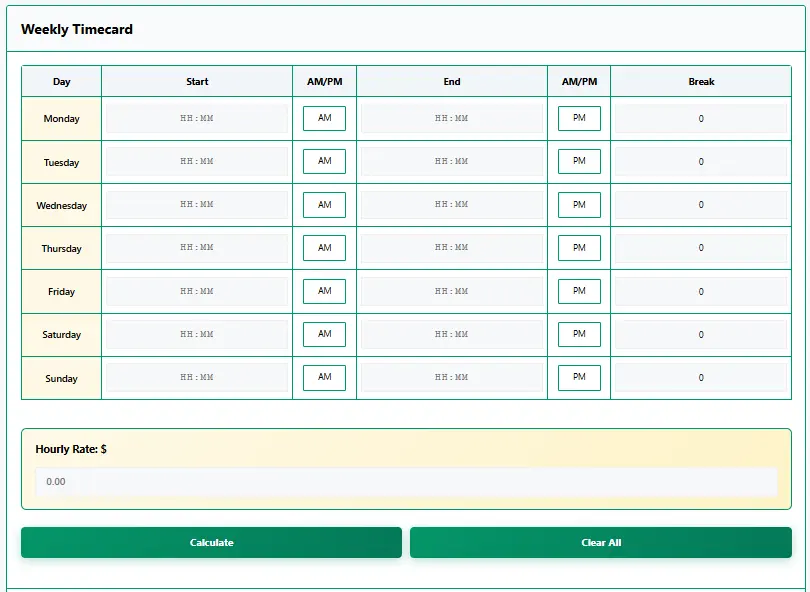
| Day | Start | AM/PM | End | AM/PM | Break |
|---|
Total Pay: $0.00
| Day | HH:MM | Decimal | Pay |
|---|
How to Use Work Hours Calculator
Step 1: Input Start Time (Example 09:00 AM).
Step 2: Input End Time (Example 5:30 PM, 17:30 PM).
Step 3: Input Break Time (Example 45 or 60 minutes).
Step 4: Hourly rate: $50.
Step 5: Click Calculate Button.
Result: Your total work time, your overtime work time, and your daily wage, weekly is displayed below.
How to calculate Weekly Total Hours
The total work time done in a week is called Weekly Total Hours. By adding up the work time done each day, you can calculate how many hours you have worked weekly, whether you have taken leave or not. When calculating all these Weekly Total Hours, you need to add hours and minutes separately. This is the easiest way.
1. Keep a record of the start and end times of each day.
2. Write down your break minutes each day.
3. Calculate the net minutes of the day, using Formula (End − Start) – Break.
4. Add the all hours or minutes of seven days.
5. Total hours should be calculated (if it is in minutes, it will be converted to hours)
Example,
Weekly Timecard
- Monday : 8h:30 min
- Tuesday : 8h:00 min
- Wednesday : 9h:00 min
- Thursday : 8h:30 min
- Friday: 8h:00 min
- Saturday : 7h:00 min
- Sunday : holiday
Weekly Total : 49h:00 min and (OT: 9h)
How to do Break Deduction?
Whether or not to deduct breaks depends on the company’s policies, but most companies give their employees a 30-45 minute break after working 8 hours in a row, while many companies give 1 hour break every 12 hours. This may not apply to all companies.
Break Rules
- Any worker must be given a minimum 30-45 minute break after working 8 hours continuously.
- Workers who work more than 8 hours must have at least 1 hour of break time.
What is Overtime Hours?. and Pay Calculate.
Overtime refers to work done in excess of standard working hours. Any company or organization that works 40 hours per weekly is called overtime.
Overtime Calculation
Regular Hours = Min(Total Hours, Threshold)
Overtime Hours = Max(0, Total Hours − Threshold)
Overtime Pay = Overtime Hours × (Hourly Rate × 1.5)
Regular Pay = Regular Hours × Hourly Rate
Total Gross Pay = Regular Pay + Overtime Pay
Example,
- Total Weekly Hours :- 52 hrs
- OT Threshold:- 40 hrs
- Regular Hours:- 40 hrs
- Overtime Hours :- 52 − 40 = 12 hrs
- Hourly Rate:- $ 200 / hrs
- Regular Pay :- 40 × 200 = $ 8,000
- OT Pay (1.5×):- 12 × 200 × 1.5 = $ 3,600
Total Gross Pay: $ 11,600
Some rules of overtime hours
But, This rule may not apply to all companies.
1. A maximum of 4 hours of overtime per day is allowed, but the company must pay for it.
2. A maximum of 24 hours of overtime per week is allowed.
3. It is mandatory to get permission from the employer before working overtime.
4. Employees under the age of 18 are not allowed to work overtime, it is against the rules.
How to Convert Digital Time to Decimal Hours
Converting hours and minutes into hours is something you will often need for payroll, timesheets, billing and time tracking.
At first it seems a little complicated. The logic of converting hours and minutes into decimal hours is actually very simple once you understand the pattern of converting hours and minutes into decimal hours.
Let us break down the process of converting hours and minutes into hours in a clean and practical way.
What Does hh:mm Format Mean?
The hh:mm format is really simple. It shows us the time of day in hours and minutes. The hh:mm format is made up of two parts:
- hh is the hours
- mm is the minutes
For examples
- 2:30 Means 2 hours and 30 minutes.
- 0:45 Means 45 minutes.
- 8:15 Means 8 hours and 15 minutes.
The hh:mm format is used a lot in things like employee timesheets and work logs and time cards. The hh:mm format is very useful, for keeping track of the time we spend at work.
The Simple Formula to Convert hh:mm to Decimal Hours
For Formula,
H+m/60
Example,
3:30 (3 hours 30 minutes)
Step-by-step:
3+30/60
=3+ 0.5
= 3.5 Hours
Thus,
3:30 = 3.5 Decimal Hours
Quick Conversion Table (Helpful for Work Hours)
| hh:mm | Decimal Hours |
|---|---|
| 0:15 | 0.25 |
| 0:30 | 0.50 |
| 0:45 | 0.75 |
| 1:00 | 1.00 |
| 1:30 | 1.50 |
| 2:15 | 2.25 |
| 8:30 | 8.50 |
What is Time Rounding and when is it used?
intervals
- 5 min : Most common. 37 min = 35 min
- 6 min : Standard in freelance billing. (1 hr = 10 units)
- 15 min : Most common in factory and shift based work.
How does it work?
When dividing the actual minutes by the interval, round to the nearest integer, and multiply by the interval again.
Formula :- Rounded = round(actual min ÷ interval) × interval
Example,
37 min ÷ 5 = 7.4 → round → 7 × 5 = 35 min
When to use it, when not to use it?
In the work hours calculator, selecting “None” will count exact minutes, which is the most accurate. Use the Rounding Only option only if your company has a timesheet policy that requires it.
FAQS For work hours calculator
How to calculate work hours?
A: The hours worked in a day from start to finish are called work hours. The hours are calculated by subtracting the start time from your end time, and if you have taken a lunch break, that is also subtracted, and the remaining hours are the total work hours. For example, If you work from 9:00 AM to 5:00 PM and take a 1-hour lunch break, your total work time is 7 hours. Working Time Calculator can record how many days or hours you have worked daily, weekly, and monthly for tracking your salary and time.
How many hours do I work per week?
A: Calculate the total number of hours that you work every day during the week. This will give you the total number of hours worked for the week, which should be 40 hours per week but actual hours may vary depending on your job.
How do I calculate overtime hours?
A: Overtime hours are those hours in addition to the regular working hours of the employer. For example, most nations consider anything beyond 40 hours in one week as overtime, although there are differences in labor laws from country to country.
How do I convert work hours into payroll hours?
A: Payroll hours refer to all the worked hours minus the unpaid break hours. The employer may choose to round off the hours depending on company policy.